This article is intended as general information only and should not be relied on as legal, environmental or site-specific compliance advice. Oily sludge disposal arrangements should be based on the waste produced, any classification or hazardous assessment carried out, and the specific duties that apply to the site and waste stream.
Oily sludge is one of those waste streams that can look straightforward at first glance. It may appear to be little more than a dirty residue left behind by machinery, separators, tanks or industrial cleaning. In practice, however, oily sludge can vary significantly depending on where it comes from and what it contains.
That is why disposal should always begin with classification, not assumption. The appropriate treatment or disposal route depends on the sludge’s composition, the process that created it and any hazardous properties it may display.
Industrial sites often produce oily sludge through:
-
Tank and interceptor cleaning
-
Vehicle wash bays and drainage systems
-
Machinery maintenance and engineering work
-
Manufacturing and production lines
-
Oil-water separators
-
Industrial cleaning and decontamination
Different sources can produce very different wastes. A sludge containing only traces of oil may need to be managed differently from one containing solvents, heavy metals or contaminated water.
Why oily sludge can require special handling
Oily sludge is generally best kept separate from other waste streams because mixing it with general waste, water, or other industrial residues can make disposal more difficult and, in some cases, more expensive.
Depending on its composition and source, oily sludge may need to be assessed under UK waste classification guidance to determine whether it is hazardous waste. Waste containing oils, fuels, chemicals, heavy metals or other contaminants may fall into that category.
The UK waste classification technical guidance explains that waste should be assessed against its source, composition and hazardous properties before an appropriate code and treatment route are chosen.
In practical terms, oily sludge may present risks such as:
-
Fire risk where oil residues are present
-
Environmental pollution when the waste leaks or enters the drains
-
Health risks for staff handling the material
-
Additional disposal costs if the wrong route is used
-
Delays if the waste is rejected by a treatment facility
The key takeaway is simple. The more accurately the waste is identified at the start, the easier it becomes to store, transport and dispose of it correctly.
What should happen before oily sludge is removed from the site
The starting point is to identify what the sludge actually is.
That will often involve reviewing:
-
Where the sludge came from
-
What substances may have been mixed with it
-
Whether previous analysis or sampling exists
-
Whether the waste has changed over time
For some sites, a visual inspection and process review may be enough to understand the likely waste stream. In other cases, particularly where contamination is possible, laboratory analysis may be needed to support classification.
The guidance on hazardous waste consignment notes on our website explains why waste descriptions and paperwork should reflect the actual material being moved rather than a broad or assumed label.
Once the waste has been identified, the next stage is to decide whether it should be treated as hazardous. Waste classification is best confirmed before transport is arranged, because this affects:
-
The paperwork that will be required
-
The type of carrier that can move the waste
-
The treatment facility that can accept it
-
The way the waste should be stored beforehand
The GOV.UK guidance on disposing of hazardous waste provides further information on the responsibilities of businesses that produce or hold hazardous waste.
How oily sludge should generally be stored before collection
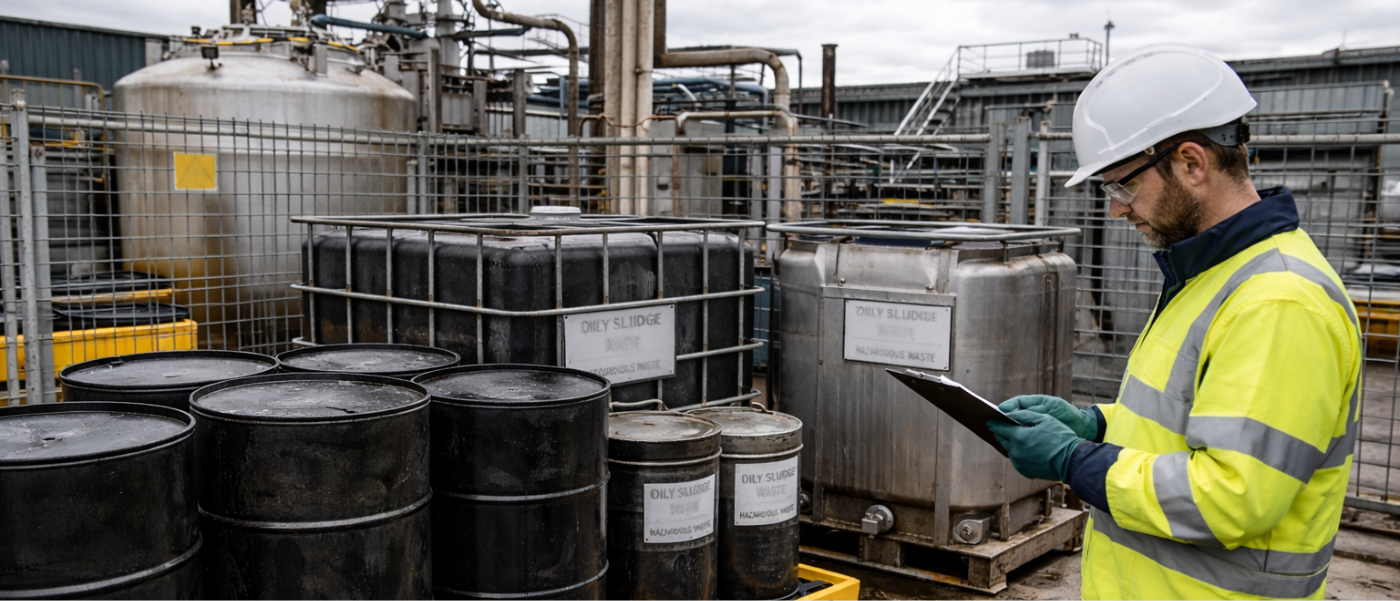
Before oily sludge is moved off-site, suitable storage will often include sealed, compatible containers or tanks, a clearly designated holding area, and controls to reduce the risk of leaks, mixing or pollution.
For many industrial sites, this may involve:
-
Using closed containers that are suitable for oily or contaminated waste
-
Keeping oily sludge separate from general waste and other liquids
-
Positioning containers in a secure area away from drains
-
Using secondary containment where there is a risk of leaks or spills
-
Clearly labelling the waste so it can be identified correctly later
The pollution prevention guidance for businesses recommends taking steps to reduce the risk of leaks, spills and contamination where oil-based wastes are stored.
Storage conditions matter because oily sludge can become harder to manage if containers are left open, mixed or allowed to build up over long periods.
Signs that a review may be needed include:
-
Containers are filling faster than expected
-
Frequent spills or minor leaks
-
Difficulty identifying what is stored in each container
-
Waste is being kept in unsuitable areas because storage space is limited
If those issues are becoming familiar, it is usually a sign that the current disposal arrangements need to be reviewed.
The documents that may be needed when oily sludge is collected
If the oily sludge is classified as hazardous, its movement will generally need to be supported by the relevant hazardous waste consignment documentation.
The documentation should accurately describe the material being moved, including:
-
The waste description
-
The appropriate waste code
-
The quantity being transferred
-
Details of the producer, carrier and receiving site
Accurate documentation helps demonstrate how the waste was classified, transferred and received, and supports traceability if questions arise later.
For non-hazardous oily sludge, other transfer paperwork may still be required. The Waste Duty of Care Code of Practice requires businesses to store waste safely and securely and to transfer it only to an authorised person, supported by the correct information.
Our article on commercial waste duty of care explains these wider responsibilities in more detail and why accurate records matter.
Common mistakes that can make oily sludge disposal more difficult
Most problems with oily sludge disposal do not begin when the waste leaves the site. They usually begin much earlier.
Some of the most common issues include:
|
Mistake |
Why does it create a problem |
|
Mixing oily sludge with other waste |
This can change the classification and make disposal more expensive |
|
Storing waste in open or damaged containers |
Increases the risk of leaks, pollution and rejected collections |
|
Assuming the waste is non-hazardous |
Can lead to incorrect paperwork or the wrong disposal route |
|
Leaving waste on site for too long |
Creates operational pressure and may increase risk |
|
Using vague descriptions on paperwork |
Makes it harder for treatment facilities to identify and accept the waste |
A traditional lesson from waste management is that it is nearly always easier to deal with waste correctly at the point it is produced. Trying to untangle mixed or poorly labelled oily sludge later is rather like trying to put toothpaste back in the tube. It is possible in theory, but no one enjoys the job.
Why specialist support matters for oily sludge disposal
Oily sludge disposal is rarely just a case of arranging collection and moving it off-site. The more difficult part is making sure the waste has been identified properly, stored safely, kept separate from other materials and prepared for transfer through the appropriate authorised route.
For sites managing oily sludge as part of wider industrial activity, specialist support can help bring classification, storage, collection planning and documentation into a more manageable process. Our industrial services are designed to support more complex waste streams and site conditions, including oily residues and difficult-to-handle industrial materials. If oily sludge is becoming harder to manage on your site, visit our industrial services page to see how we can help.
Sites dealing with oily sludge often need support that goes beyond a single collection. At Kane Enviro, we support industrial operations with a wider range of waste management and environmental services that help bring difficult waste streams under better control.
A practical checklist before arranging collection
Before oily sludge leaves the site, it helps to review the basics:
-
Confirm where the sludge came from
-
Check whether it may need a hazardous assessment
-
Keep it separate from other waste streams
-
Store it in suitable, sealed containers
-
Make sure the description and paperwork match the material
-
Check that the waste carrier and receiving site are authorised
Our guide to how long hazardous waste can be stored on site may also be useful if waste is building up faster than expected.
In summary
The safest and most effective way to dispose of oily sludge from industrial processes is to treat it as a classification-led process rather than a simple collection job.
The appropriate disposal route depends on what the sludge contains, whether it may be hazardous, how it has been stored and what documentation is needed.
By identifying the waste early, keeping it separate and arranging collection through the right authorised route, you can reduce risk, avoid unnecessary delays and make the whole process far easier to manage.