

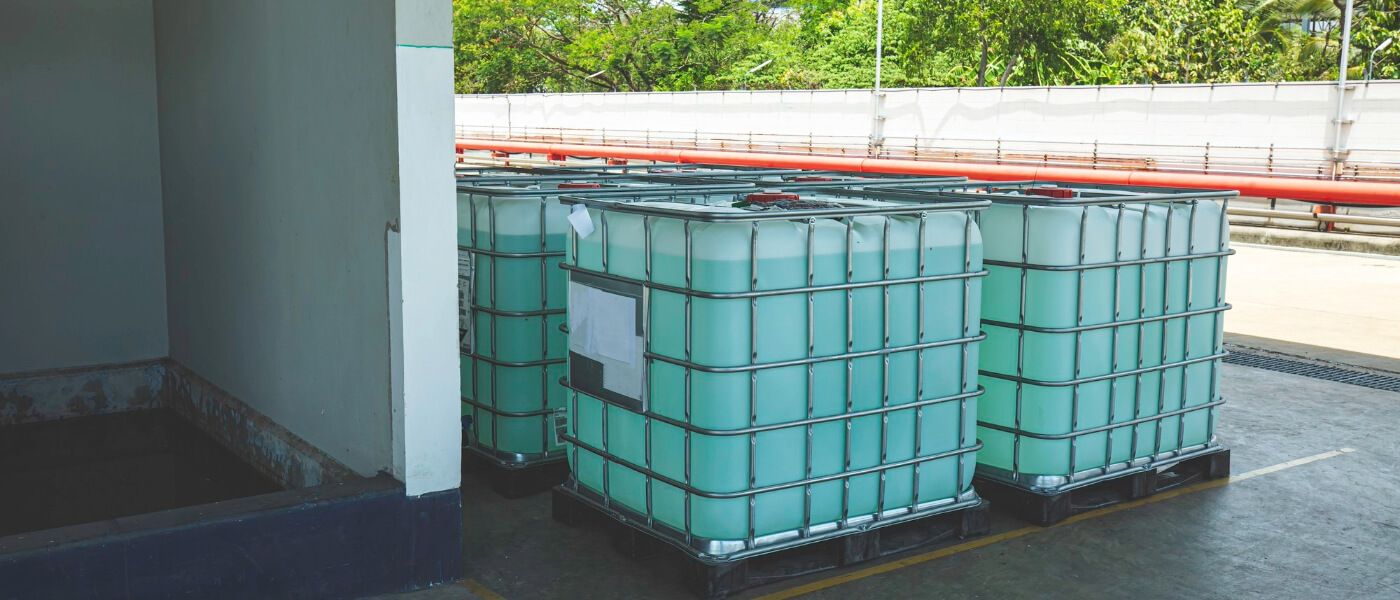
Secondary containment is often overlooked until something goes wrong, which is exactly why it matters. When a primary container leaks, fails, or is accidentally overfilled, secondary containment gives you a controlled place for liquid to go, instead of letting it spread into drainage systems and the wider environment.
We see it used across oils, chemicals, fuels, and liquid wastes, but the principle stays the same. The HSE describes secondary containment as a recognised technical measure for preventing, controlling, or mitigating loss of containment events.
Below, we set out the requirements in a clear, practical way, including what to check, what to document, and what typically goes wrong.
The requirements for secondary containment (clear checklist)
Secondary containment is “good” when it meets all four requirements below. Miss one, and the system becomes unreliable when you need it most.
Requirement 1: It must have sufficient capacity
The containment system must be sized to hold a credible release. For oil storage, a widely used benchmark is:
-
At least 110% of the largest container’s capacity, or
-
25% of the total volume stored, whichever is greater
That baseline is reflected in official guidance on bund capacity expectations for oil storage.
Capacity also needs to be real, not theoretical. When checking usable volume, account for displacement and “lost” space caused by:
-
Tank supports and plinths
-
Pipework, valve boxes, and pump skids
-
Access steps, ladders, or platforms
-
Silt, debris, and residues
-
Rainwater left sitting in the bund
Requirement 2: It must be impermeable and compatible with the liquid
Secondary containment must retain what it captures. That means the containment surface and any liner system should be:
-
Impermeable (no seepage through walls, base, joints, or penetrations)
-
Compatible with the stored liquid and any residues or cleaning agents
-
Resistant to deterioration over time (cracking, corrosion, seam failure)
This requirement is where “looks fine” can be misleading. A bund can appear intact while joints, penetrations, or liners have begun to fail.
Requirement 3: It must capture the likely leak points, not just the tank
Containment must be positioned so it catches leaks from the parts of the system that actually leak in real life.
Good practice is to ensure the contained area also covers:
-
Fill points and couplings
-
Valves, filters, and pump connections
-
Sight gauges, vents, and overfill lines
-
Flexible hoses and quick-release fittings
-
Decanting and transfer points where connections are handled
If the bund surrounds the tank but the fill point or pump skid sits outside it, you have containment on paper, but not in practice.
Requirement 4: It must be managed and evidenced through routine controls
Secondary containment is not a “fit and forget” control. It needs routine management so it remains ready, and it needs documentation so it is defensible.
A practical routine typically includes:
-
Keeping bund drain valves locked and normally closed
-
Removing rainwater only through a controlled process
-
Keeping the contained area clear (no “temporary” storage inside it)
-
Inspecting integrity and leak indicators on a consistent schedule
-
Updating capacity assumptions when storage arrangements change
-
Maintaining records that can be retrieved quickly during audits or incidents
Where you need a more formal assurance angle, IChemE has published useful details on inspection of secondary and tertiary containment systems, particularly around integrity verification and inspection focus.
What counts as secondary containment?
Secondary containment is an engineered measure outside the primary container that is designed to capture and retain a release. In plain terms, the primary container holds the product. Secondary containment is what contains it if the primary container does not.
Common secondary containment options we see on site
-
Bunded areas (masonry, concrete, steel, or polymer)
-
Bunded pallets and trays for drums and IBCs
-
Drip trays beneath valves, filters, pumps, and loading points
-
Double-skinned tanks or integral bunded tanks
-
Sumps and interceptors as part of drainage management
For higher-risk storage and more complex layouts, CIRIA’s resources on designing containment systems to prevent pollution provide a useful risk-based framework for selection, sizing, and detailing.
Choosing the right solution: a quick comparison
|
Option |
Best for |
Strengths |
Watch-outs |
|
Bund wall and base (concrete or steel) |
Fixed tanks, permanent storage zones |
Durable, scalable, engineered solutions |
Joints and penetrations are critical, inspections still required |
|
Bunded pallets and trays |
Drums and IBCs |
Fast deployment, modular, easy to relocate |
Limited capacity, can be overwhelmed by larger spills |
|
Double-skinned or integral bunded tanks |
Single-tank set-ups |
Built-in containment, tidy footprint |
Still needs attention to fill points and pipework |
|
Drip trays at points of use |
Pumps, valves, decanting areas |
Captures drips and minor releases |
Not a substitute for a full container failure |
We often see the strongest outcomes with a layered approach: bund for storage, plus point-of-use capture where connections are made and broken.
Operational controls that support the requirements
Even a well-built bund can fail as a control measure if it is poorly managed. The most effective set-ups are the ones where inspections are routine, records are retrievable, and changes to storage are reflected in capacity checks.
Requirements can vary by substance, storage configuration, and regulatory expectations. That is why site-specific checks and risk assessment matter, even when you are using standard capacity benchmarks.
A weekly inspection routine (short and practical)
A practical routine usually covers:
-
Any free liquids in the bund, remove safely where appropriate
-
Damage, cracking, corrosion, or liner deterioration
-
Drain valve position, confirm it is locked and closed
-
Signs of leaks at fittings, hoses, and pumps
-
Housekeeping, keep access clear and capacity intact
-
Changes in set-up that reduce capacity or move leak points outside containment
Keeping secondary containment checks consistent
Most compliance friction is caused by inconsistency: capacity assumptions that do not match what is actually stored, bunds that slowly lose usable volume, or inspection records that cannot be located when needed. A practical system focuses on reducing that inconsistency.
At Kane Enviro, we help organisations keep containment expectations, inspection routines, and documentation aligned so controls are easier to maintain and evidence.
We support a broad mix of operational environments, which is why the same issues crop up in different ways. Our work spans multiple sectors, including manufacturing settings where liquid handling and storage changes are part of business as usual.
If you want a straightforward next step to strengthen your containment checks and compliance trail, our reporting support is a practical starting point.
Where secondary containment meets liquid waste reality
Not every spill response is a simple wipe-down and carry on. Captured liquids, contaminated absorbents, and any washdown generated during clean-up need a compliant route off-site. This is where we often see the gap between “we have bunding” and “we have a workable system”.
Secondary containment should link cleanly into your waste arrangements so the aftermath is controlled, documented, and handled through the right route. When liquids are left sitting in containment because no one is confident about the next step, risk management quietly turns into risk storage.
If you want support managing liquids generated by leaks, maintenance, or spill response, our liquid waste service is a practical starting point for getting captured liquids handled properly.
The key takeaway is…
Secondary containment works when it meets four requirements: sufficient capacity, impermeability and compatibility, coverage of likely leak points, and routine management backed by evidence. Get those right and containment becomes a dependable control measure, not a box-ticking exercise.
Written by Kane Enviro’s environmental compliance team. For questions about your specific set-up, you can reach us via the contact page.