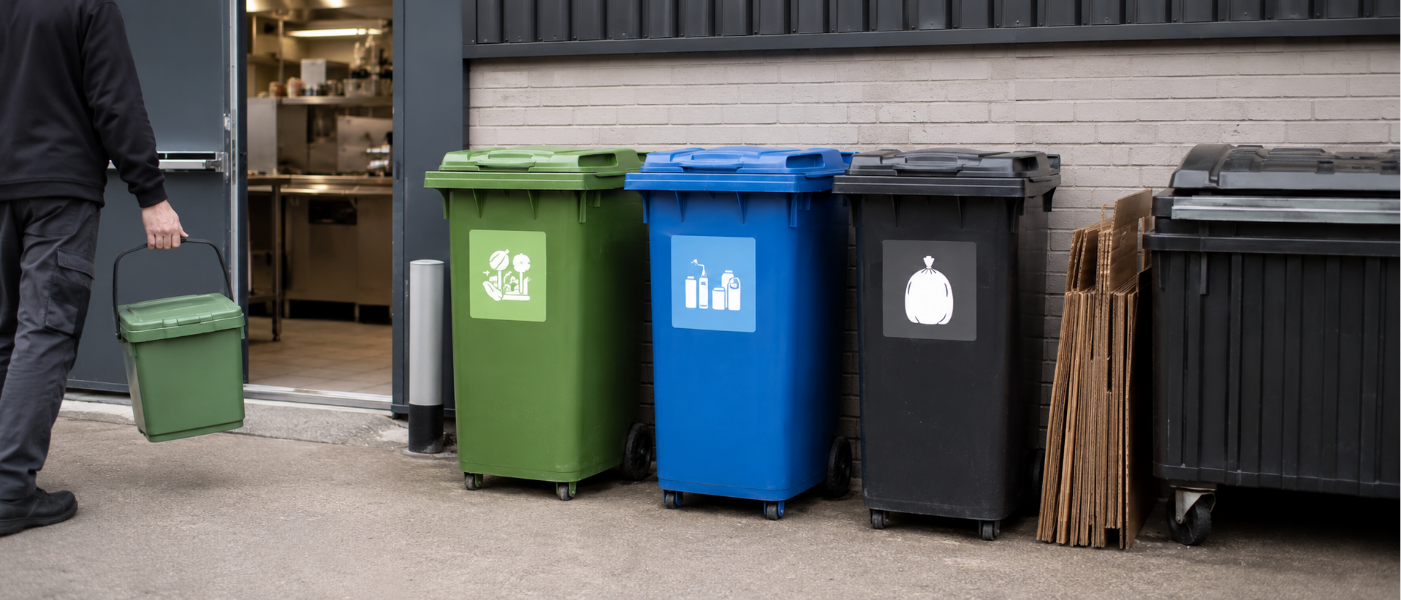
This article is for general information only and should not be treated as legal advice. Commercial food waste rules can differ across England, Wales, Scotland and Northern Ireland, and requirements may change over time. Businesses should check current guidance for their premises or seek professional advice where needed.
Food waste is easy to underestimate. A few staffroom caddies, catering leftovers, plate scrapings or out-of-date products can quickly become a regular commercial waste stream. It is also one of the waste types most likely to cause odours, contamination and storage issues when it is mixed with general waste.
That is why commercial food waste legislation UK guidance matters for businesses. The rules are not simply about adding another bin. They are about separating food waste properly, storing it sensibly, keeping records and making sure waste follows a suitable route.
At Kane Enviro, we help businesses practically look at food waste: where it is produced, how it is stored, how often it needs collecting and whether the current arrangement is still fit for the site.
Why commercial food waste rules need careful checking
Food waste rules are not identical across the whole of the UK. England, Wales, Scotland and Northern Ireland each have their own requirements and guidance, so businesses should check what applies to their premises.
That matters for multi-site organisations. A business with sites in more than one part of the UK may need different collection arrangements, storage routines or staff guidance depending on where each site operates.
The safest approach is to treat food waste as a distinct waste stream and check:
-
Whether food waste must be separated on-site
-
Which premises are covered
-
Whether any size or threshold rules apply
-
How food waste should be stored before collection
-
Whether the packaging must be kept out of food waste
-
What records are needed when waste is transferred
Official guidance on workplace recycling rules sets out the position for workplaces in England, including separate food waste collection requirements and the micro-firm exemption timeline.
What counts as commercial food waste?
Commercial food waste is food waste produced by a business or non-domestic premises. It is not limited to restaurants, cafés or commercial kitchens.
It can include:
-
Food preparation waste
-
Plate scrapings
-
Spoiled or expired food
-
Fruit peelings and cores
-
Tea bags and coffee grounds
-
Bakery or production waste
-
Staffroom food waste
-
Customer leftovers
-
Unsold food that cannot be redistributed
-
Catering waste from meetings, events or hospitality areas
One common mistake is assuming that a workplace does not produce food waste because it does not prepare food. Staff kitchens, vending areas, meeting rooms and customer areas can still create food waste that needs to be considered.
Which businesses should review their food waste setup?
Food waste separation can be relevant to many types of business, not only food-led premises.
|
Business type |
Where food waste may arise |
|
Offices |
Staff kitchens, break rooms, and meeting catering |
|
Hospitality businesses |
Kitchens, customer areas, and plate waste |
|
Retailers |
Damaged stock, expired food, and staff areas |
|
Manufacturers |
Production waste, staff canteens, spoilage |
|
Education settings |
Canteens, staffrooms, events |
|
Leisure and venues |
Visitor bins, catering points, events |
|
Facilities-managed sites |
Tenant areas, shared kitchens, contractor welfare |
|
Construction projects |
Welfare units, canteens, packaged meals |
The legal position may depend on location, business size, waste volume and the type of premises. For that reason, food waste should not be left as a vague part of “general waste”. It needs to be identified clearly.
Key food waste legislation points to understand
The details differ by nation, but the direction is clear: food waste should be separated from general waste where the rules require it, and businesses must handle waste responsibly.
England
Under Simpler Recycling, businesses and relevant non-domestic premises are required to separate dry recyclable materials, food waste and residual waste. The rules apply from 31 March 2025 for most workplaces, with micro-firms given until 31 March 2027.
Government guidance defines micro-firms as businesses with fewer than 10 full-time equivalent employees across the business, not just at a single site.
Wales
Workplace recycling rules in Wales have required businesses, charities and public sector organisations to separate specified recyclable materials from 6 April 2024. Food waste is one of the separated streams where it is produced.
The Welsh Government’s workplace recycling guidance is the best starting point for businesses checking their duties.
Scotland
Scotland has separate food waste requirements, so businesses should check current guidance from the relevant environmental regulator before setting up or changing collections. Food businesses should not assume that the same thresholds, exemptions or collection duties apply across every UK nation.
SEPA’s guidance on recycling and food waste for business explains the requirements that apply to business waste and food waste separation.
Northern Ireland
Northern Ireland also has separate food waste requirements. NetRegs guidance on disposing of food waste and catering waste states that businesses producing more than 5kg of food waste per week are required to have a separate collection of that waste.
This is why blanket statements are risky. “UK food waste law” may be a useful search phrase, but the practical answer depends on the rules that apply to the site.
What should not go in a food waste bin?
Food waste bins should be kept as clean as possible. Contamination can create problems for collection and treatment.
As a general rule, food waste containers are for food material, not packaging. Compostable or biodegradable packaging should not be assumed suitable for food waste unless your collector confirms a dedicated route accepts it.
|
Item |
Typical handling consideration |
|
Plate scrapings |
Usually food waste |
|
Tea bags and coffee grounds |
Usually food waste |
|
Fruit and vegetable peelings |
Usually food waste |
|
Clean cardboard |
Dry recycling, where accepted |
|
Plastic packaging |
Separate recycling or residual waste, depending on condition and collector guidance |
|
Compostable packaging |
Only if accepted by the collection route |
|
Used cooking oil |
Separate collection route |
|
Food-contaminated packaging |
Check the collector guidance |
Used cooking oil should not be poured down drains. Where it is produced in quantity, it normally needs a separate collection arrangement.
Why food waste separation affects business costs
Food waste can create costs beyond collection. It is wet, heavy and can quickly affect bin storage areas if collections, containers or staff routines are not right.
Keeping food waste separate may help businesses:
-
Reduce contamination in dry recycling
-
Keep general waste volumes clearer
-
Improve hygiene around waste storage
-
Reduce odours from mixed waste
-
Understand where food waste is being produced
-
Match container sizes to real waste volume
-
Keep better waste transfer records
The cost point should not be overstated. Separating food waste will not automatically reduce costs for every business. The benefit depends on waste volume, current collection arrangements, contamination levels and how the site operates.
Follow the food and drink waste hierarchy
Before thinking only about collection, businesses should look at whether food waste can be prevented. The official food and drink waste hierarchy sets out a preferred order for dealing with surplus and waste food.
In practical terms, businesses should consider:
-
Preventing surplus and waste where possible
-
Redistributing suitable surplus food where safe and appropriate
-
Sending suitable material for animal feed where rules allow
-
Recycling food waste through routes such as anaerobic digestion or composting
-
Avoiding disposal routes where better options are available
This does not mean every business can reuse or redistribute food. Food safety, storage conditions and business operations all matter. The point is to review food waste before it reaches the bin, not only after it has become a collection problem.
How to set up food waste separation on-site
A good food waste system should be clear, convenient and realistic. If the food waste bin is hidden in the wrong place, staff will use the nearest general waste bin. The bin always wins when the system is awkward. Not noble, but true.
Start with a simple site check:
-
Where is food eaten or prepared?
-
Where are leftovers currently disposed of?
-
Are staffroom bins mixed with general waste?
-
Are customer-facing bins clearly labelled?
-
Are internal caddies emptied often enough?
-
Is the external food waste bin secure and accessible?
-
Is packaging being separated from food?
-
Are staff clear on what should not go in food waste?
Once these points are clear, the collection setup can be matched to real use rather than guesswork.
Bin placement, signage and storage
Food waste separation often succeeds or fails at the bin level. Staff should not have to walk across the building to do the right thing.
Useful steps include:
-
Put food waste bins near where food is produced or eaten
-
Pair food waste bins with general waste and recycling where possible
-
Use plain labels rather than vague wording
-
Keep internal caddies clean and easy to empty
-
Check bins for packaging contamination
-
Review outdoor storage for pests, odour and access
-
Update staff guidance when collections change
Our guide to what waste segregation means explains why separating waste at source is central to better waste handling.
Where Kane Enviro’s food waste service fits
For many businesses, the challenge is not knowing that food waste needs to be separated. It is turning that requirement into a collection setup that works day to day.
Our food waste management service can support practical commercial food waste collections, with arrangements shaped around the type and volume of waste produced. This can help businesses separate food waste more clearly from other waste streams and manage collections with the right supporting documentation.
Visit our food waste management service page to see how a more structured collection arrangement could support your site’s food waste responsibilities.
Keep duty of care records
Food waste is still commercial waste, so the duty of care applies. The official waste duty of care code of practice sets out responsibilities for businesses that produce, carry, keep, treat, dispose of or otherwise control waste.
In practical terms, businesses should be able to show:
-
What waste was produced
-
How it was described
-
Who collected it
-
Where it was taken
-
Whether the carrier was authorised
-
What transfer records were kept
For businesses managing multiple streams, waste reporting support can help provide clearer visibility of waste data, service information and documentation.
Commercial food waste compliance checklist
Before changing your collection setup, use this checklist to identify the basics.
|
Check |
What to confirm |
|
Premises |
Which rules apply to each site? |
|
Food waste sources |
Where is food waste produced? |
|
Separation |
Is food waste kept out of general waste? |
|
Packaging |
Are packaging and food waste being separated correctly? |
|
Containers |
Are bins the right size and in the right place? |
|
Storage |
Are odour, pests and access being managed? |
|
Collection |
Does frequency match the volume produced? |
|
Documentation |
Are waste transfer records available? |
|
Staff guidance |
Do staff know what goes where? |
The key takeaway
Commercial food waste legislation in the UK is not a single one-size-fits-all rule. Businesses need to check the requirements that apply to their premises, then make sure food waste is separated, stored, collected and documented properly.
The practical starting point is simple: find where food waste is produced, check whether it is being mixed with other waste, review bin placement and make sure collection frequency matches real use.
If your food waste setup is unclear, mixed with general waste or difficult for staff to follow, speak to our team, and we can help you review a more practical commercial food waste arrangement.