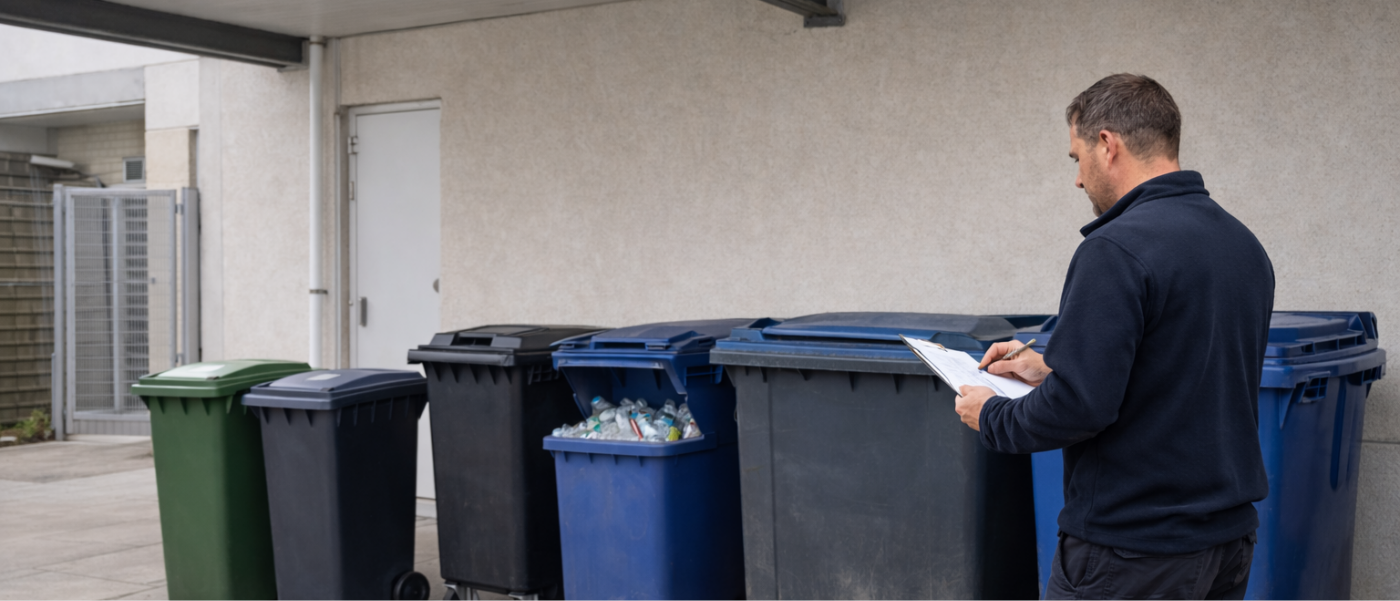
Getting your trade waste bins right can make a noticeable difference to how smoothly a site runs.
When the setup fits the site properly, waste stays contained, recycling is easier to manage, and service areas are less likely to become cluttered. When it does not, the problems show up quickly. Bins overflow, cardboard gets stacked beside containers, staff use the wrong waste streams, and collections start feeling either too frequent or not frequent enough.
The official business waste guidance makes clear that businesses must store waste safely and securely before collection. In practice, that means choosing containers that suit the waste you actually produce, placing them in a way that works for the site, and setting a collection schedule that reflects real usage rather than guesswork.
At Kane Enviro, we often review sites where the waste setup no longer matches the way the site actually operates. Sometimes volumes have increased. Sometimes the layout has changed. Sometimes collections have stayed the same while everything else around them has shifted.
So the real question is not just which bins to order. It is how to choose a setup that works day to day, stays manageable during busy periods, and supports safe, compliant storage before collection.
Start with the waste your site actually produces
Before looking at bin sizes or collection days, it helps to step back and look at the waste itself.
Many sites are still using a bin arrangement inherited from a previous occupier, an earlier layout, or a service plan that no longer reflects current demand. That usually leads to one of two outcomes. Either the site does not have enough capacity in the right places, or it is paying for containers that do not match what is being produced.
Identify the main waste streams
A typical commercial site may produce some combination of:
-
general waste
-
mixed recycling
-
cardboard
-
food waste
-
glass
-
specialist or hazardous waste
The right balance depends on the site. An office may need modest general waste capacity but more room for recycling and cardboard. A hospitality site may need tighter planning around food waste and glass. A warehouse, school, or mixed-use premises may need a broader combination depending on how different areas operate.
Our guide to what waste segregation means in practice is useful here, because good segregation begins with giving people the right containers in the right places.
Look at real volume, not assumptions
This is where many bin setups drift off course. General waste often gets used as the catch-all solution when the real issue is that cardboard, food waste, or recycling volumes were underestimated from the start.
You do not need a major audit to spot the basics. Even a short review over a week or two will usually show where the pressure is building. Useful things to look for include:
-
Which bins fill first
-
Which bins are regularly underused
-
Whether overflow happens on certain days
-
Whether waste peaks are seasonal
-
Whether specific areas produce different waste types
If cardboard is always left beside a bin, that tells you something. If general waste is lifted half empty every week, that tells you something, too.
Choose bins that fit the site, not just the waste volume
Once you understand the waste streams and volume, the next step is choosing containers that fit the site properly.
This is not just a question of size. The right setup also depends on access, layout, storage space, and how people actually move around the waste area.
Smaller bins for tighter or lower-volume sites
Wheelie bins can work well where:
-
Space is limited
-
Waste volumes are lower
-
Containers need to be moved more easily
-
Several waste streams must fit into a compact area
They are often a sensible choice for offices, schools, smaller hospitality venues, and sites with enclosed waste bays or rear access areas where larger containers would be awkward.
Larger bins for more consistent output
Larger lidded trade waste bins are often more suitable where:
-
Waste volumes are steady and higher
-
Cardboard or mixed recycling builds up quickly
-
The site has a dedicated service yard
-
Collections need to be more efficient
Their advantage is capacity. Their downside is that they can take up too much room if the layout is already tight or if the site is not producing enough to justify them.
Larger containers for bulkier waste
Some sites produce bulkier or heavier waste that is not well-suited to standard wheelie bins. In those cases, larger containers or skips may be more practical.
This is often relevant for warehousing, facilities operations, refurbishment work, or sites where packaging waste builds up in larger quantities. Our page on construction waste support shows how quickly container choice starts to matter when the waste profile changes across the week.
Bin planning is also about layout
Two sites producing roughly the same amount of waste may still need very different bin setups.
That is because layout matters just as much as volume. A spacious service yard can support larger containers and clearer segregation. A narrow rear service lane may need a more compact arrangement with tighter planning around spacing, access, and collection points.
When reviewing the layout, it helps to consider:
-
How much storage space is actually available
-
Whether containers block service routes, doors, or walkways
-
Whether staff can use the bins easily during busy periods
-
Whether different waste streams are easy to identify
-
Whether the storage area remains tidy between collections
More bins do not automatically improve a site. In some cases, adding another container simply makes the area more awkward and pushes the real problem elsewhere.
How to set the right collection frequency
Once the bins are broadly right, collection frequency becomes the next big decision.
This is often where sites either overspend or run into avoidable storage problems. Collections that are too infrequent usually lead to overflow, clutter, and poor segregation. Collections that are too frequent can mean paying for capacity that is not really being used.
Signs your collections are too infrequent
You may need more frequent lifts if you are seeing:
-
Bins regularly overflow before collection day
-
Loose sacks or cardboard stored beside containers
-
Odour issues from food waste
-
Staff are moving waste between bins to make space
-
Service areas are becoming harder to keep tidy
Signs your collection pattern may be too high
It may be worth reviewing the schedule if:
-
Bins are consistently underused
-
Some containers are always partly empty at lift time
-
One waste stream is under pressure, while another rarely fills
-
Occupancy, opening hours, or site use have changed since the service was set
It is common for collection schedules to stay unchanged long after the site itself has shifted.
This is where a structured trade waste service becomes especially useful, because the right service does more than collect waste. It helps match container type, placement, and collection timing to the way your site actually works. If your current setup feels like it is always either overflowing or underused, that is usually the first place to review.
A quick comparison of common planning issues
|
Issue |
What it usually points to |
|
General waste bins overflow every week |
Capacity too low, or the lifts are too infrequent |
|
Cardboard is stacked beside the bins |
Cardboard volume underestimated |
|
Recycling bins stay half empty |
Over-capacity or weak segregation |
|
Staff use the wrong bins |
Layout or waste stream separation is unclear |
|
Waste areas feel cramped |
Too many containers or poor positioning |
|
Food waste causes odour problems |
Collections are too far apart |
The best setup is the one that fits the site properly, not the one with the highest number of containers.
Why this matters for compliance as well as convenience
Choosing the right trade waste bins is not just an operational decision. It also supports compliance.
The Waste Duty of Care: Code of Practice makes clear that businesses must prevent waste from escaping, store it properly, transfer it only to authorised persons, and keep the right records. If bins are overflowing, waste is stored beside containers, or streams are mixed because the setup is unclear, it becomes much harder to show that waste is being handled well.
That is one reason why bin reviews should be looked at alongside service performance and waste data. Our reporting support helps businesses see which waste streams are filling fastest, where overflow is happening, and whether collection patterns still reflect how the site is operating.
Common mistakes when choosing trade waste bins
We regularly see the same issues appear:
-
Choosing bins based on guesswork rather than actual volume
-
Keeping an old setup after the site has changed
-
Using extra general waste capacity to hide poor segregation
-
Underestimating cardboard or food waste
-
Adding more bins when the real issue is layout
-
Leaving collection schedules unchanged during seasonal peaks
Most bin and collection problems start small. Over time, the whole setup becomes harder to manage than it needs to be.
The key takeaway
Choosing the right trade waste bins is really about matching your containers and collection frequency to the way your site actually works.
That means understanding what waste you produce, how quickly it builds up, how much space you have, and whether your current setup is helping staff keep waste separated and contained. The right arrangement supports smoother operations, tidier storage areas, and stronger compliance. The wrong one usually shows up in overflow, clutter, and avoidable cost.
This article is intended as general guidance rather than site-specific operational advice, because the best bin mix and collection pattern depend on the layout, waste profile, and working pattern of each site. If your bins are constantly full, your service area feels cramped, or your collections no longer reflect demand, it is probably time to review the setup properly.
And if you want practical help assessing your current arrangement, you can contact us to discuss the most sensible next step.